Diepgaand onderzoek door De Duurzame Driehoek / In-depth research by De Duurzame Driehoek
13.06.2026 : Gas raakt op, de wind kan gaan liggen en de zon schijnt best vaak achter de wolken. Waar vinden we een stabiele duurzame warmtebron? Het antwoord is: onder onze voeten. English follows the Dutch text
Het kacheltje van Moeder Aarde gaat nog miljarden jaren mee en de zon verwarmt haar oppervlak. Hoe benutten we die bodemwarmte? We laten water opwarmen in een buis (het gesloten systeem) of we gebruiken grondwater (het open systeem).
Voor het eerste systeem wordt vlakbij de woning een verticaal gat geboord tot zeg 150 meter diep. In dat boorgat wordt een U-vormige buis aangebracht, de bodemlus, waarin water met anti-vries wordt rondgepompt. De warmte van dat water, met een temperatuur van ruim 10˚ C, wordt in huis door een bodemwarmtepomp gebruikt om het water binnen op de gewenste verwarmingstemperatuur te krijgen. Zonder verwarming kan er ook worden gekoeld. Dit systeem is geschikt voor individuele woningen, voor groepjes nabij gelegen woningen en, met een slimme verdeling van bodemlussen, voor een hele buurt.
De tweede mogelijkheid is om bodemwarmte te benutten voor een collectief mini-warmtenet. Er wordt een grotere ondergrondse "warmwater bron" aangeboord en via een technische ruimte wordt het water verdeeld naar een aantal woningen. Na warmteafgifte wordt het afgekoelde water teruggepompt naar een op enige afstand gelegen "koudwater bron". In de woningen gaat het net als bij een eigen bodemlus: een bodemwarmtepomp zorgt voor de gewenste watertemperatuur. Bij dit systeem, warmte-koude opslag of WKO, zijn minder boringen nodig maar heb je wel een gezamenlijke installatie die beheerd moet worden. Een voordeel is dat het in de zomer efficiënter kan koelen, vanuit de koudwater bron.
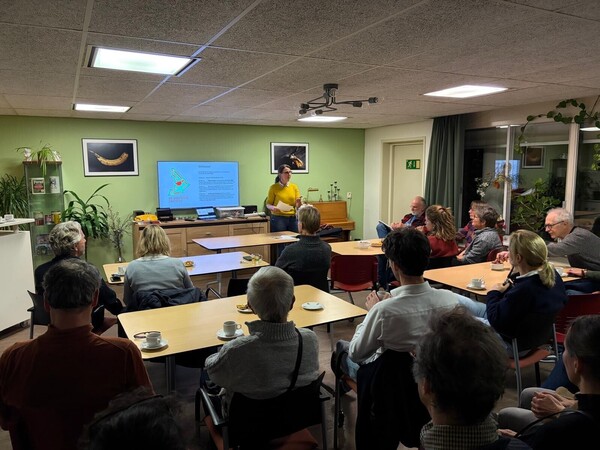
Tijdens de laatste Algemene Ledenvergadering (ALV) van vereniging De Duurzame Driehoek legde Lotje Meijknecht de voordelen en uitdagingen van deze twee warmteoplossingen uit (foto). Behalve het al genoemde grote voordeel van een stabiele warmtebron zijn er meer voordelen. De put en de aanvoerleidingen zitten buiten onzichtbaar onder de grond en er is geen hinderlijk brommende buitenpomp (allebei essentieel voor een rijksmonument als de Krophollerdriehoek). Bovendien is het rendement van een bodemwarmtepomp een stuk hoger dan dat van een lucht-water warmtepomp, met een hoger subsidiebedrag als mooie bijvangst. En niet te vergeten: beide varianten zijn flexibel in de zin dat niet alle woningen even goed geïsoleerd hoeven te zijn. Wie beter isoleert kan toe met een minder sterke bodemwarmtepomp.
De uitdagingen zorgen voor de volgende vragen: waar in huis komt de bodemwarmtepomp (formaat grote koelkast)? Waar komen zonder al te veel gedoe de leidingen? Hoe zit het met vloerverwarming en oude radiatoren? Welke minimale woning-isolatie is nodig? Wie beheert de technische ruimte? En, niet te vergeten, hoeveel gaat dit allemaal kosten?
Tijdens de ALV besloten de leden dat het maken van een project-onderbouwing (“business case”) van elk van deze twee bodemwarmte-oplossingen nu voorrang heeft. Werkgroep en bestuur van de vereniging zijn daar inmiddels druk mee bezig. Ook Energiek Leiden en Gemeente Leiden zijn bij deze activiteit betrokken.
Wie meer wil weten over bodemwarmte kan op het internet van alles vinden, en kan ook terecht bij Energiek Leiden (vernieuwde website!) of bij De Duurzame Driehoek (krophot@gmail.com).
Bovendien, wie wil helpen met dingen uitzoeken, tips en ervaringen is van harte welkom!
In-depth research by De Duurzame Driehoek
Gas is running out, the wind may die down, and the sun often shines behind the clouds. Where can we find a stable, sustainable heat source? The answer is: beneath our feet. Mother Earth's heater will last for billions of years, and the sun warms her surface. How do we utilize that geothermal heat? We heat water in a pipe (the closed system) or use groundwater (the open system).
For the first system, a vertical hole is drilled near the home to a depth of, say, 150 meters. A U-shaped pipe, the ground loop, is installed in that borehole, through which water containing antifreeze is circulated. The heat from that water, with a temperature of well over 10°C, is used inside the house by a ground source heat pump to bring the indoor water to the desired heating temperature. Cooling is also possible without heating. This system is suitable for individual homes, for groups of nearby homes, and, with a smart distribution of ground loops, for an entire neighborhood. The second option is to utilize geothermal heat for a collective mini-heat network. A larger underground "hot water source" is drilled, and the water is distributed to a number of homes via a technical room. After heat release, the cooled water is pumped back to a "cold water source" located at some distance. Inside the homes, the process works just like with a private ground loop: a ground source heat pump ensures the desired water temperature. With this system, thermal energy storage (TES), fewer boreholes are required, but you do have a shared installation that needs to be managed. An advantage is that it can cool more efficiently in the summer, drawing from the cold water source.
During the last General Meeting (ALV) of the association De Duurzame Driehoek, Lotje Meijknecht explained the benefits and challenges of these two heating solutions (photo). In addition to the major advantage of a stable heat source already mentioned, there are other benefits. The well and the supply pipes are located outside, invisible underground, and there is no annoying humming outdoor pump (both essential for a national monument like the Krophollerdriehoek). Moreover, the efficiency of a ground source heat pump is significantly higher than that of an air-to-water heat pump, with a higher subsidy amount as a nice bonus. And let's not forget: both variants are flexible in the sense that not all homes need to be equally well insulated. Those with better insulation can manage with a less powerful ground source heat pump.
The challenges raise the following questions: where in the house will the ground source heat pump be placed (the size of a large refrigerator)? Where will the pipes be installed without too much hassle? What about underfloor heating and old radiators? What minimum level of home insulation is required? Who will manage the technical room? And, not to forget, how much will all this cost?
During the General Meeting, the members decided that creating a project justification (“business case”) for each of these two ground source heat solutions now takes priority. The association's working group and board are currently hard at work on this. Energiek Leiden and the Municipality of Leiden are also involved in this activity. Anyone wishing to learn more about geothermal heating can find plenty of information on the internet, and can also contact Energiek Leiden (updated website!) or De Duurzame Driehoek (krophot@gmail.com).
Furthermore, anyone willing to help with research, tips, and experiences is most welcome!
